
 English
 Español
 日本語
 Deutsch
 Pусский
 Français
 Portugues
 العربية
 ไทย
 Bahasa indonesia
 עברית
Most inverter datasheets look alike. Input voltage, output voltage, rated watts, waveform. The line that decides your system layout is easier to miss: which way can power flow?
A standard inverter goes one way. DC in, AC out, end of story. A bidirectional inverter also goes back, taking AC from shore power or a generator to put charge into the battery.
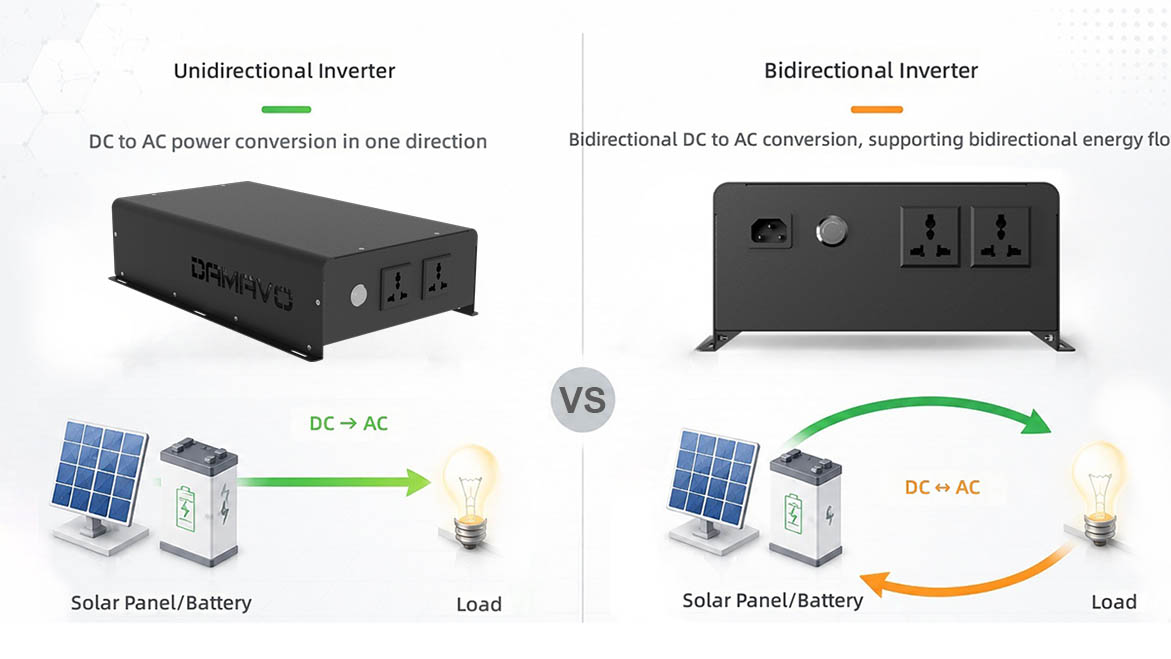
One difference, three consequences: fewer boxes, less cable, and a different set of questions to settle before you sign off the drawing.
The short version
- A standard inverter only converts DC from the battery into AC.
- A bidirectional inverter also converts AC back into DC, so the same unit can charge the battery.
- "Inverter charger" is the older term for the same idea, but the label promises less than the feature list does.
- Bidirectional does not mean full rated power in both directions at the same time.
- The DAMAVO YM1486 series covers 2,000W, 3,000W and 5,000W at 48V DC in, 220V AC out.
1. What a Bidirectional Inverter Actually Does
Strip the label off and it is a bridge with two working directions.
In inverter mode the unit behaves like any other inverter: DC from the bank is switched into a clean 50 Hz or 60 Hz sine output. In charging mode the same power stage runs in reverse, rectifying the AC input and regulating it down to a voltage and current the battery will accept.
The hardware is the easy half. The rest is control logic: detecting whether AC is present, deciding whether to pass it through, holding the charger stable when a compressor starts halfway through a cycle, dropping back to inverter mode the moment the cable is pulled. That firmware is what separates a real bidirectional unit from an inverter and a charger sharing one enclosure, and it is a big part of the price gap.
1.1 The naming problem, and why it costs people money
Sales material treats "bidirectional inverter" and "inverter charger" as synonyms. They usually are not. Bidirectional describes the direction of power flow; inverter charger describes what ships inside the housing. A bidirectional DC-DC converter moves power both ways and contains no AC charger at all. Neither label promises automatic transfer switching, shore power bypass, or UPS-grade changeover.
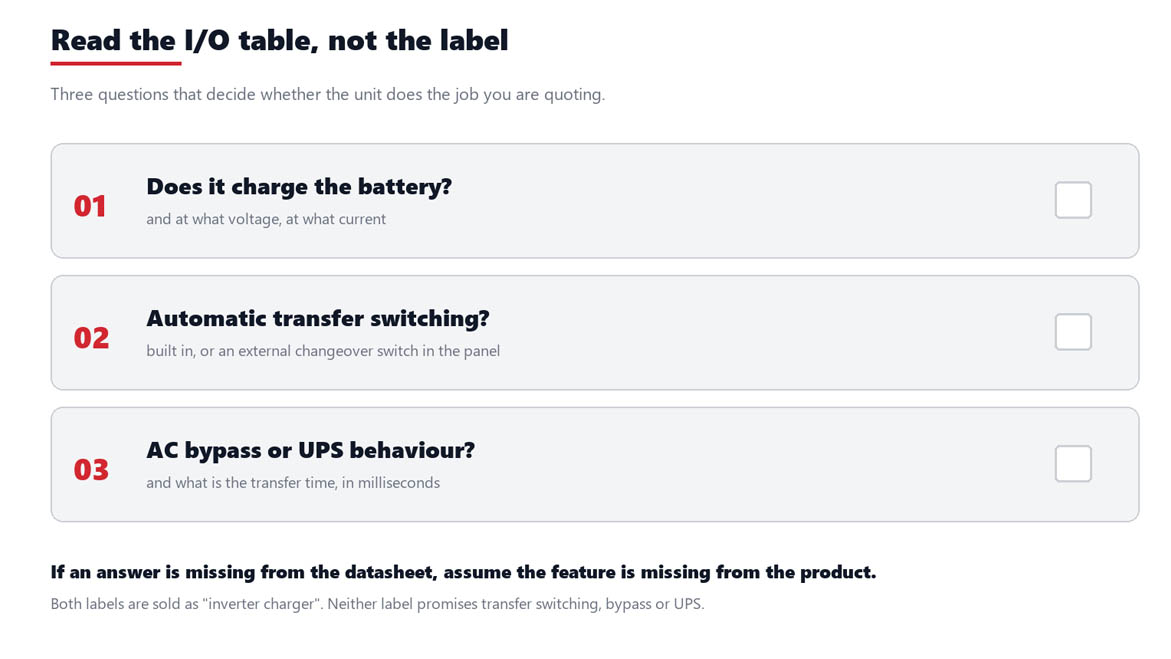
So read the I/O table instead, then ask three questions:
- Does it charge the battery, at what voltage and what current?
- Does it include automatic transfer switching, or do I still need an external changeover switch in the panel?
- Does it support AC bypass or UPS behaviour, and what is the transfer time?
If an answer is missing from the datasheet, assume the feature is missing from the product.
2. What a Standard Inverter Does
One direction. DC in, AC out.
For a large share of builds that is the whole job. A work truck running a laptop and a cooler off the starting battery does not need a charger built into its inverter. A solar-charged cabin already has an MPPT controller handling every amp going into the bank.
2.1 The familiar RV example
A 12V, 24V or 48V bank feeds the inverter, which produces 110V or 220V AC for a TV, a laptop, a coffee maker, a small induction plate. When the bank drops, the battery gets charged some other way: a standalone charger, a DC-DC unit off the alternator, or solar through an MPPT controller.
Two waveform families dominate this market. Modified sine wave is cheaper and fine for resistive loads and simple motors, but it makes some electronics hum, run hot, or refuse to start. Pure sine wave behaves like mains power, which matters for anything with a compressor, a motor, or a switch-mode supply inside. Our pure sine wave inverter range covers the mid-power band most RV and marine panels are built around, and it is usually the safer default when the load list is not finalised yet.
For sensitive electronics and household appliances, DAMAVO pure sine wave inverter solutions may be a suitable option.
2.2 Where it stops
No AC input means no shore-power charging. When the customer plugs into campground power, something else has to turn that AC into DC: a second enclosure, a second set of fuses, another two to four metres of heavy cable, another thing that can fail in the field.
That is not a defect. It is what happens when the job is split across two products. The mistake worth avoiding is quoting a standard inverter into a system that clearly needs shore charging, then adding a charger later once the customer notices. The total lands higher than the integrated option and the wiring is worse.
3. Side-by-Side: The Differences That Change Your BOM
Rated power is the number everybody compares and the number that decides the least. What moves system cost is how many devices, cables and terminations the power path needs.
| Comparison | Standard Inverter | Bidirectional Inverter |
| Power conversion | DC to AC | DC to AC and AC to DC |
| Battery power supply | Yes | Yes |
| AC battery charging | Usually not included | Supported when designed with charging functions |
| External battery charger | Needed for AC charging | Usually not needed with an integrated charger |
| System components | Inverter and separate charger if needed | Can combine inverter and charger functions |
| System integration | Separate devices may be required | More integrated design |
| Typical applications | Battery-powered AC loads | Battery power and AC battery charging |
Read the last row twice. On a single-unit comparison the bidirectional model always looks expensive. On a system comparison it often is not, because the charger, the changeover hardware, the extra cable and the labour hours were going to be paid for anyway.
Two questions settle it, and neither is about the inverter. Does the battery ever get charged from an AC source? Does the panel have room for a second enclosure? When those answers conflict, price both systems properly before choosing. If you want to compare different inverter types and power options, explore the full DAMAVO power inverter range.
4. How Power Moves Through the System
Almost every specification error we see comes from a drawing where the two directions were treated as one.
4.1 The two paths
Inverter mode: DC battery → bidirectional inverter → AC loads
Charging mode: Shore power / generator → bidirectional inverter charger → DC battery
Inverter mode is ordinary sizing work: continuous load plus a margin for whatever starts without warning. Charging mode is where systems quietly go wrong. A charger sized for a 200Ah bank will crawl through a 600Ah lithium bank, and the customer reads it as a faulty product. Worse, an aggressive charge profile with no BMS communication can trip a lithium pack's protection mid-cycle and leave the system offline until somebody resets it.
4.2 Five checks before you commit
- Battery voltage and the charge profile the bank expects.
- AC input voltage, frequency, and maximum input power.
- Continuous output power, and the surge the loads will actually demand.
- Whether the battery BMS can talk to the charger, and over what protocol.
- Whether the project needs external transfer switching or UPS behaviour.
One clarification belongs in the quote itself: bidirectional conversion means two modes are available. It does not promise full rated power both ways at once, and it does not promise simultaneous full output and full charging. The product design decides that, and the number belongs in the specification, not in an assumption.
5. Where Bidirectional Inverters Earn Their Price
5.1 RV and camper builds
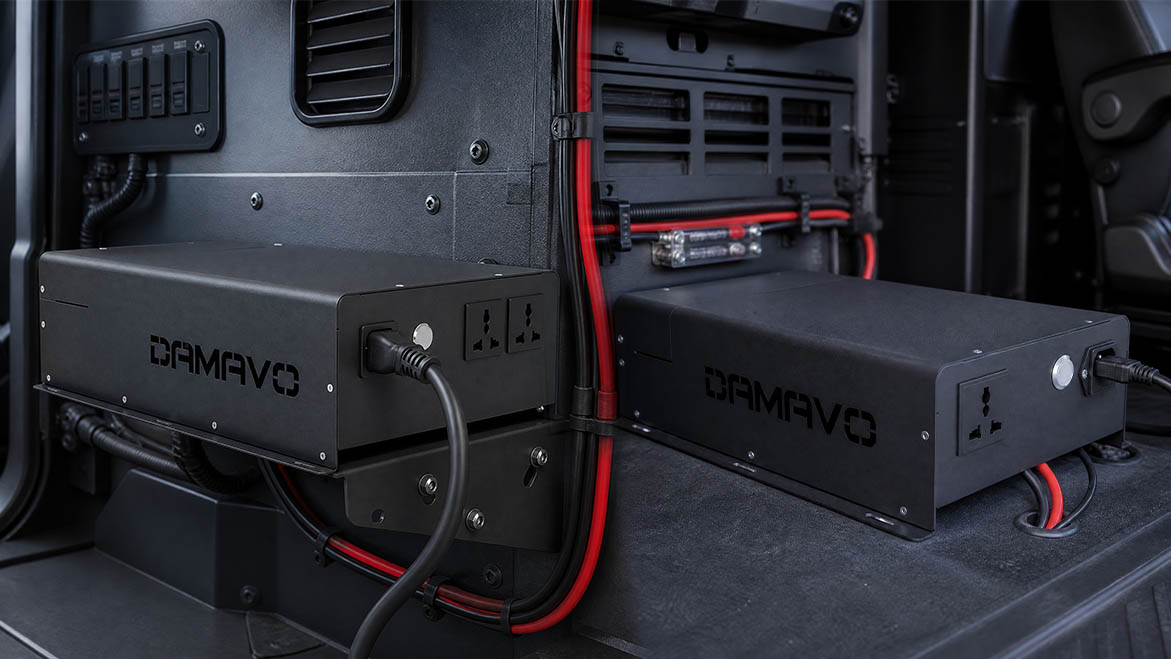
An RV lives two lives. Driving and boondocking, it runs on the battery. Parked with the cable plugged in, it wants to charge. A bidirectional inverter covers both halves without asking the owner to understand what changed, which matters more than it sounds: users do not know which mode the system is in, and they should not have to.
For builders the win is packaging. One unit on the equipment wall instead of three, shorter AC runs, a tidier distribution area, fewer harnesses to document. Our RV, trailer and camper applications page shows how these units sit alongside the rest of the 12V and 24V hardware in a typical build.
5.2 Marine
Boats carry the same three sources: onboard bank, shore power, often a generator. A bidirectional unit supplies AC from the bank and takes shore or generator power back into the batteries when available.
Marine adds constraints that are not optional. Input voltage and frequency have to match the berth, so 50 Hz and 60 Hz markets cannot share one SKU without checking. Installation space is tight and often poorly ventilated, and salt air will find any enclosure that is not sealed properly.
5.3 Off-grid power systems
Off-grid is where the arrangement shows its weak point most clearly, so state it plainly: solar panels do not connect to the AC side. They need an MPPT controller between the array and the bank. Some hybrid inverters include that controller; most bidirectional inverters do not.
Where the array is undersized, a generator through the inverter charger is a reasonable backup. Size it against the load and the charge current together, because the unit will try to do both at once.
6. How to Specify One: The OEM Checklist
6.1 Battery voltage
Confirm 12V, 24V or 48V before anything else. A mismatch is not something you can wire around; the unit either refuses to run or damages something.
The 48V question deserves its own note. A 48V inverter cannot be fed from a 12V bank by rearranging cables. It means a 48V battery configuration, its own protection devices, and a wiring plan built for the current that configuration carries.
6.2 Load math
Total everything that might run together, then add the starting surge of motors, compressors, pumps and anything with a transformer. A fridge compressor drawing 100W running can pull several times that for a second or two on start. If two start together, the inverter sees a number nobody wrote down.
6.3 Charging capacity and battery compatibility
Check rated charging power and current, not just the inverter side. Capacity has to suit the bank size, the limit the battery maker specifies, and how fast the customer expects to be back at full. A charger that is too small turns an overnight stop into a two-day stop. One that is too large gets limited by the BMS anyway, so the extra money buys nothing.
Lithium and lead-acid want different things: absorption voltages, float behaviour, temperature compensation, and whether the charger stops at a voltage the BMS agrees with or pushes through it. Ask specifically whether it supports the chemistry in the build and whether it can talk to that battery's BMS.
6.4 System compatibility
Then check the whole panel. AC voltage and frequency must match the market. Generator output quality matters, since a rough generator can upset a charger that was happy on shore power. Wiring, breaker ratings, protection functions, mounting space and ventilation all belong in the drawing review.
For OEM buyers, technical specifications are only one part of supplier evaluation. You should also review engineering support, production control, quality management and customization capabilities. Read our power inverter manufacturer guide for OEM buyers before selecting a long-term supplier.
7. The DAMAVO YM1486 48V Series
For projects that need both directions in one enclosure, the YM1486 series is our 48V pure sine wave bidirectional platform. DC-to-AC inversion and AC-to-DC charging sit in the same product family, which is what lets a builder collapse three devices into one.
7.1 Power ratings
| Model | DC Input | AC Output | Rated Power |
| YM1486-48V2KW | 48V | 220V AC | 2,000W |
| YM1486-48V3KW | 48V | 220V AC | 3,000W |
| YM1486-48V5KW | 48V | 220V AC |
5,000W
|
Charging power tracks the model rather than sitting at one fixed figure across the range, so match the charge side to your bank instead of assuming the largest inverter charges fastest. Tell us the bank size and chemistry and we will confirm the configuration on paper first. The YM1486-48V5KW page carries the detailed specification for the largest unit.
7.2 Where it fits, and where it does not
The 48V input puts this series in the mid-size segment: camper and RV panels with a proper lithium bank, boat systems with shore charging, off-grid cabins with generator backup, light industrial or mobile equipment that needs AC on board.
It is the wrong product for a 12V accessory circuit, and the wrong product where the load list never exceeds a few hundred watts. Down that end a simple standard inverter does the job for less, and pretending otherwise is how quotes lose credibility.
DAMAVO has spent 24 years building power and lighting products, certified to IATF 16949 and ISO 9001, with more than 4,000 models developed for vehicle, marine, railway and industrial customers.
8. Questions Buyers Actually Ask

Q1. Can a bidirectional inverter charge batteries from shore power or a generator?
A1: Yes, if the inverter has a built-in AC charger and supports the power source's input requirements. Before connecting shore power or a generator, check the AC input voltage, frequency, waveform quality and maximum input power. The available power must also be sufficient for both connected AC loads and battery charging.
Q2. Can a bidirectional inverter power AC loads and charge the battery at the same time?
A2: Some bidirectional inverter chargers support both functions at the same time. However, this depends on the internal design, AC bypass function and available input power. For system integration, check the maximum AC input capacity and charging power. Do not assume the unit can deliver its full rated output and charging power simultaneously.
Q3. Can a bidirectional inverter work with solar panels?
A3: Yes, but the setup depends on whether the inverter has a built-in MPPT solar controller. If it does not, an external solar charge controller is normally required to manage power from the panels and charge the battery. Check the inverter's specifications to confirm whether it supports direct solar input or requires a separate controller.
Q4. What is the difference between a bidirectional inverter and a hybrid inverter?
A4: A bidirectional inverter converts power in both directions: DC to AC and AC to DC. A hybrid inverter typically combines multiple energy sources, such as solar panels, batteries and grid power. It may also include MPPT solar charging and energy management functions. The actual features vary by model and manufacturer. Always check the product specifications before selecting a solution.
Q5. What bidirectional inverter models does DAMAVO offer?
A5: DAMAVO offers the YM1486 series of 48V bidirectional inverters, with rated power options of 2kW, 3kW and 5kW. The series supports DC-to-AC conversion and AC-to-DC battery charging, with 220V AC output. Charging specifications and other functions vary by model. For detailed information, please refer to the DAMAVO YM1486 bidirectional inverter specifications.
Q6. Does DAMAVO support OEM/ODM bidirectional inverter projects?
A6: Yes. DAMAVO provides OEM/ODM services for power and lighting products. For bidirectional inverter projects, available customization options depend on the selected product platform and technical requirements.
To help our team evaluate your project, please share:
- Application: RV, marine, off-grid or other equipment
- Battery specifications: DC voltage, battery type and capacity
- AC requirements: Input and output voltage, frequency and rated power
- Charging requirements: Required charging power
- Project details: Estimated order quantity, target market and required certifications
Our team can review your requirements and discuss a suitable configuration for your project.
Important Safety Note
Always confirm that the inverter's DC input voltage, AC input and output ratings, battery specifications and wiring meet the system requirements before installation. Use suitable cables, fuses and circuit protection, and follow the manufacturer's installation instructions. Installation and electrical connections should be handled by qualified professionals.
Looking for a Bidirectional Inverter for Your Project?
Whether you are developing an RV power system, a marine application or an off-grid solution, DAMAVO can help you evaluate your requirements and explore suitable inverter options.
With OEM/ODM experience in power and lighting products, our team can discuss product specifications, customization requirements and project needs.
Explore our power inverter range or contact DAMAVO to discuss your project and request a quotation.


